There is a point in life at which a car ceases to be about how fast it can go and begins to be about how well it can fit into your life.
You need enough space to seat the family.
Enough space for luggage.
Enough power for the motorway.
Something comfortable when the road trip is five hours rather than one.
And if possible something that doesn’t make you swear every time you fill it up.
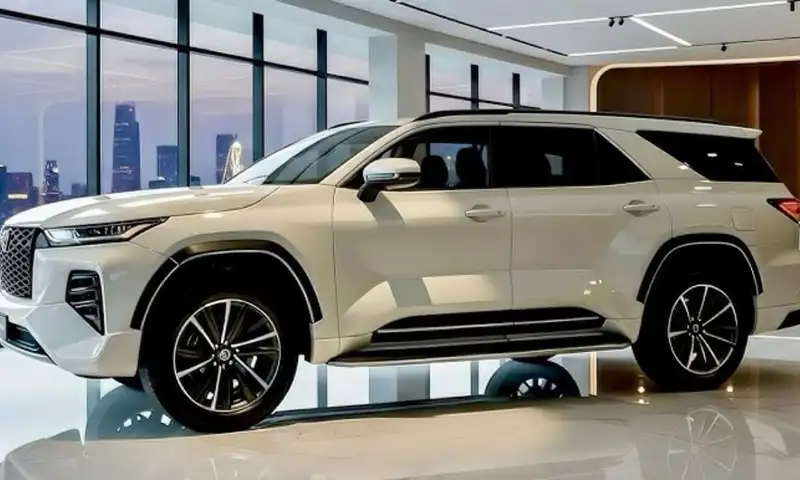
That is roughly the new 2026 Toyota Highlander.
It’s not Toyota’s largest SUV, nor is it the most rugged. It lacks the boxy personality of a Land Cruiser and it doesn’t pretend to be as sports car-like as some of the younger crossovers taking over the market.
Instead, it seems the Highlander adheres to a surprisingly straightforward formula: make a roomy three-row SUV, make it comfortable, offer a choice of petrol and hybrid powertrains, and let Toyota’s good name do most of the talking.
For 2026, Toyota is making one very significant change. All petrol Highlander models are now AWD as standard and the Hybrid goes on being standard AWD. But the more you’re in the Highlander, the more you come to see it as a vehicle built for authentic family life, rather than showroom drama.
The 2026 Highlander media info
Highlander is a mid-size suv that’s big enough to allow three rows of seats.
It’s possible to seat seven to eight people, depending on how it is arranged. Models with second-row captain’s chairs have seven seats, while some XLE and Limited models are available with a second-row bench to seat eight.
There are two broad powertrain options.
The regular Highlander is powered by a 2.4-litre turbocharged four-cylinder petrol engine with 265 horsepower and 310 lb-ft of torque.
Then there is the Highlander Hybrid, which uses a 2.5-litre four-cylinder petrol engine with electric motor-generators.
The petrol version has a combined 24-mpg manufacturer-estimate, while the hybrid gets combined 35-mpg ratings.
That difference in itself might be enough to tip the scales for some buyers toward the hybrid.
How much will the 2026 Toyota Highlander sell for?
For the US market, the 2026 Highlander’s cheapest gas-powered trim will be the XLE, which will start at $46,270. The price range for the latter is $35,985 and $49,560.
Slightly more at $48,020 is the start and for the hybrid.
The trims start with the petrol Highlander XLE, XSE and move up to Limited and Platinum. The hybrid is available in XLE, Limited and Platinum. These are US MSRP figures, so they should not be treated as UK prices.
That distinction is especially important for British readers. The Highlander isn’t currently listed by Toyota UK as part of its regular new car range as it is in the US, so there’s no straightforward on the road price for this 2026 model.
For anyone looking up that vehicle from Britain, therefore, the 2026 Highlander is better envisioned as a US-market SUV unless Toyota explicitly tells otherwise.
The petrol engine is stronger than you’d imagine
Unlike before where you had the basic Highlander equipped with a 3.5-litre naturally aspirated V6 engine.
It makes 265 hp and 310 lb-ft of torque, which is a good amount of pulling power for the family SUV.
In fact, that torque number is more important than the power number.
Greg Berard, Motor Trend When you’ve got seven people in the car and a boot full of luggage and a yet a motorway up ahead, all you really care about is making sure you have loads of low- and mid-range torque.
Nobody wants to smash the accelerator pedal just to get a fully-loaded SUV to keep up with traffic.
The turbocharged engine should make that kind of driving relatively effortless.
Toyota has also incorporated the use of balance shafts within the engine to aid in smoothing out vibration, which suits the overall personality of the Highlander. It’s supposed to be composed and not agricultural.
Then we have the Highlander Hybrid
In the eyes of many customers this is the more interesting model.
The Highlander Hybrid pairs a 2.5-litre four-cylinder petrol engine with two electric motor-generators. All 2026 Highlander Hybrid models feature Toyota’s Electronic On-Demand AWD system.
The manufacturer’s official estimated fuel economy is 35 mpg combined.
That’s a pretty substantial improvement over the 24 mpg combined rating for the petrol model.
Needless to say, the real difference for you on the road will be how you drive your car.
Who can particularly well benefit from the hybrid system Traction DeSmog: Well someone who does plenty of city driving there’s gonna be a lot of opportunity for energy recapture under braking and use electric assistance at relatively low speeds.
A driver who “lives” on the motorway, just about every day will have a very different experience with the hybrid car and himself.
But the core benefit remains: you can have three rows of seats and all-wheel drive without taking on the fuel consumption that goes with a big petrol SUV.
How much better does AWD really add?
The 2026 Highlander’s entire lineup now features all-wheel drive as standard.
This is an important change as Toyota used to split the is drivetrain options across models .
Next year, the petrol ones will all get standard AWD, and the hybrid will keep its Electronic On-Demand AWD system. This doesn’t make the Highlander a Land Cruiser.
It is still a road-biased, family SUV at heart.
But extra traction can come in handy when the roads are wet, icy or snowy.
Especially for those of us who live in areas of the United States that have severe winters.
As far as British drivers are concerned, the upside probably lies more in wet, muddy car parks and occasional winter driving than any serious off-road capabilities.
Seven seats sound good. But are they actually usable?
This is where three-row SUVs can sometimes underwhelm.
A brochure can say seven seats, but the last row occasionally looks like it was conceived putting children and luggage together.
The Highlander is more utilitarian in approach.
The second row offers a choice of either captain’s chairs or a bench seat (depending on model), and the third row can be used to seat extra family members or occasional passengers.
And when you do not have use for all those seats, you can fold down the rear rows to make way for a bigger load space.
Toyota offers up to 84.3 cubic feet of cargo space with the second and third rows folded down.
That’s a handy figure, but the more important question is how that space is used in day to day life. A family SUV must work for shopping trips one day and suitcases the next.
It’s got to handle the sports equipment and school bags and all the other stuff that for some reason somehow clamours in a family car.
If that seems like straightforward, run-of-the-mill, parenting logic, that’s because it is. The Highlander’s adaptable seating is meant for just that.
The cabin is purposefully a space that appeals to families
There’s nothing about the Highlander’s interior that suggests it’s trying to be some kind of futuristic spaceship.
And that is probably a good thing.
With a multimedia screen at the centre, digital displays and physical controls for the most important functions, Toyota’s dashboard is rather straightforward.
Depending on the trim buyers get either an 8-inch or 12.3-inch Toyota Audio Multimedia touchscreen.
Wireless phone charging is standard, as is three-zone climate control.
That last feature might not sound that exciting until you’ve taken a long road trip with three different people as passionate about the temp.
A separate climate zone for different areas of the cabin can make family journeys noticeably simpler.
It’s one of those features that sounds dull on a spec sheet and then magically becomes something you really appreciate after you own the car.
The higher trims certainly make it feel much more luxurious, though
The Limited and Platinum models take the Highlander upmarket.
Depending on the specification, buyers can opt for leather-trimmed seats, a panoramic moonroof, ambient interior lighting and an 11-speaker JBL premium audio system. The Platinum trims the range and it is aimed at those who want a Highlander but don’t want to feel like they bought the base model of a three-row SUV.
But there is a certain value in foregoing the temptation to check all the boxes.
The Highlander’s fundamental advantages — room, refinement, hybrid efficiency and AWD — are available even further down the range.
What is the Highlander like to drive?
The Highlander is best thought of as an easygoing SUV.
It is not trying to be a sports saloon.
The steering is supposed to be predictable, the suspension is supposed to be comfortable and the cabin is supposed to be serene on long trips.
That makes sense.
A three-row 7-passenger family SUV is probably going to be doing ordinary stuff for most of its life.
Driving to work.
Taking the children somewhere.
going to the supermarket.
Heading to the airport.
Going on holiday.There’s no need for every journey to feel like an event.
Making those trips easier is the Highlander’s job.
And that’s something it appears to be especially good at.
The hybrid version has a different personality
The Hybrid feels even more at ease around town.
Electric power does enable low-speed driving to be peaceful and smooth, particularly when traffic is stop-and-go.
It’s also a little satisfying to watch the energy transfer back and forth between the petrol engine, battery and electric motors without having to do anything yourself.
You don’t plug it in.
You don’t have to plan charging stops.
You just fill up the petrol tank and go. And that simplicity is one reason Toyota’s conventional hybrids aren’t melting away into the ether as fully electric SUVs become more common.
The Highlander Hybrid is not try to replace an EV, it’s crossing the ocean to take the place of a gasoline vehicle.
It’s a different kind of tradeoff it’s making, the tradeoff).
So, should you go for petrol or hybrid?
If you take short trips and spend much of your driving time in the city, the hybrid likely sounds like the more tempting prospect.
The official combined 35 mpg figure is much higher than the petrol model’s 24 mpg combined figure.
If you tow regularly, drive long distances, or just like the sound of a turbocharged petrol engine, the regular Highlander is maybe the pick for you.
There is no such thing as a universally right answer.
It’s just a matter of how you use the SUV.
That is actually one of the nice things about the Highlander range. ”
Toyota hasn’t locked all its customers into the same powertrain.70
Final thoughts
The 2026 Toyota Highlander isn’t the kind of SUV you’re trying to get into every conversation with.
It is not attempting to be the most rugged Toyota, the fastest Toyota or the most cutting-edge Toyota.
It’s trying to be the SUV a family can rely on.
That mean three rows of seats.
A genuinely useful amount of cargo space.
Comfortable long-distance manners.
A choice of petrol or hybrid power.
And standard all-wheel drive for the entire 2026 range. The hybrid model is especially persuasive because it offers the practicality of a sizable SUV, a manufacturer-estimated 35 mpg combined figure, and the capability to tow up to 3,500 pounds.
The petrol version, on the other hand, offers customers 265 horsepower and 310 lb-ft. of torque with out the complexity of a more layered powertrain.